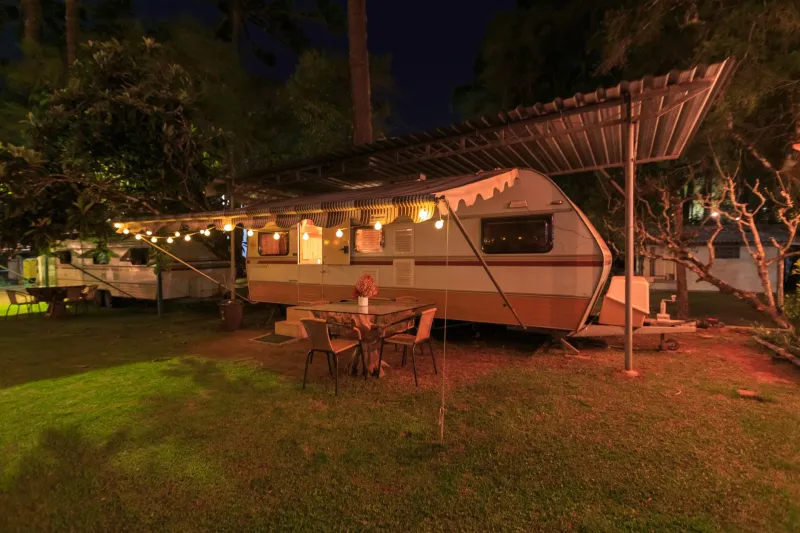
What an RV Trip Really Costs: A First-Timer's No-BS Budget Breakdown

Let's be real for a second. You saw the rental rate, did some quick math, and thought, "This is way cheaper than a hotel." Maybe it is. Maybe it isn't. The truth depends entirely on what you're counting — and most first-timers aren't counting nearly enough.
An RV road trip can absolutely be a budget-friendly adventure. But only if you go in with your eyes open. Here's where your money actually goes, broken down category by category, so you can build a budget that holds up in the real world.
The Rental Fee Is Just the Starting Line
You already know about the daily rate. What surprises most renters is everything layered on top of it. Depending on the platform and rental company, you may also be looking at:
- Generator fees — often charged per hour of use, typically $3–$5/hour
- Mileage overages — many rentals include a daily mileage cap (100–150 miles is common), with overages running $0.25–$0.45 per mile
- Cleaning fees — standard on most rentals, ranging from $75–$200 depending on the rig
- Security deposits — often $500–$1,500, held on your card for the duration of the trip
- Roadside assistance add-ons — sometimes optional, sometimes not, typically $10–$25/day
Before you sign anything, read the full fee schedule. We've written about this before, but it bears repeating: the checkout screen is where budgets quietly fall apart.
Fuel: The Big Variable Nobody Talks About Enough
Fuel is almost always the single largest out-of-pocket expense on an RV trip, and the numbers vary wildly depending on what you're driving.
- Class B camper vans: 18–25 MPG — the most fuel-efficient option
- Class C motorhomes: 10–15 MPG — middle ground in both size and cost
- Class A motorhomes: 6–10 MPG — the big rigs that eat gas (or diesel) for breakfast
Run the numbers for your trip before you commit to a vehicle class. A 2,000-mile road trip in a Class A at 8 MPG and $3.50/gallon will cost you roughly $875 in fuel alone. The same trip in a Class B at 22 MPG? About $318. That's a $557 difference — enough to cover several nights of camping.
Also factor in that RVs frequently require premium diesel, especially larger Class A rigs. Diesel prices fluctuate regionally, so check GasBuddy or a similar app before you map your route.
Campground Fees: Wildly Different Depending on Where You Stay
This is where people either save a ton of money or blow their budget without realizing it.
Free and low-cost options:
- Bureau of Land Management (BLM) dispersed camping: free in most areas
- National Forest dispersed sites: typically free
- Harvest Hosts (membership-based, ~$99/year): stay at wineries, farms, and breweries
Mid-range options:
- State park campgrounds: $20–$45/night
- National park campgrounds: $20–$35/night (plus park entrance fees)
- KOA and similar private campgrounds: $45–$75/night
Full-hookup resort-style parks:
- $60–$120+/night, with amenities like pools, Wi-Fi, and laundry
A 10-night trip with a mix of free nights and mid-range campgrounds might average out to $30–$40/night. Stay exclusively at full-hookup RV resorts and you're looking at $700–$1,000 just in campground fees. Plan your stops intentionally and mix in free nights wherever your route allows.
Food: RV Travel Doesn't Automatically Mean Cheap Eating
One of the most common assumptions new RV renters make is that cooking in the rig will save them a fortune. It can — but only if you actually cook.
Restaurant meals for a family of four can run $60–$100+ per sitting. Do that twice a day and your food budget evaporates fast. On the flip side, grocery runs and cooking in the RV can bring that same family's daily food cost down to $30–$50.
Budget tips:
- Shop at Walmart, Aldi, or Costco before you leave home — stock up on non-perishables
- Plan your meals for the first three days at minimum
- Budget for at least a few restaurant meals; depriving yourself entirely leads to bad decisions at a random truck stop
- Keep a cooler stocked with snacks to avoid gas station impulse buys
A realistic daily food budget for two adults is $40–$70 if you're cooking most meals and treating yourself occasionally.
Insurance: Don't Skip This Line Item
Most personal auto insurance policies do not cover rental RVs. Some credit cards offer limited protection, but read the fine print carefully — exclusions are common for vehicles over a certain weight or value.
RV rental insurance options typically include:
- Basic liability (often required): $10–$20/day
- Comprehensive/collision coverage: $20–$45/day
- Supplemental liability: $5–$15/day
Third-party options like Roamly or Outdoorsy's insurance marketplace can sometimes offer better rates than what rental companies bundle in. Either way, don't roll out unprotected. A fender bender in an unfamiliar 30-foot motorhome in a Walmart parking lot is not the memory you want from your vacation.
The "Just in Case" Fund: Repairs and Unexpected Costs
Something will go wrong. It might be minor — a dead house battery, a propane issue, a slide-out that's being stubborn. It might be something bigger. Budget accordingly.
For a 7–10 day trip, set aside $150–$300 as a contingency fund. If you don't use it, great — that's your celebratory dinner on the last night. But having it earmarked means a flat tire or a malfunctioning water pump doesn't derail your entire financial plan.
Also remember:
- Dump station fees: $10–$20 if you're not staying at a campground with hookups
- Laundry: $5–$15 per load at campground facilities
- Park entrance fees: National Parks charge $15–$35 per vehicle (consider an America the Beautiful annual pass at $80 if you're hitting multiple parks)
- Tolls: depending on your route, these can add up to $20–$80+
Putting It All Together: Sample Budget for a 7-Night Trip
Here's what a realistic 7-night trip for two adults in a Class C motorhome might look like:
| Expense | Estimated Cost |
|---|---|
| Rental fee (7 nights @ $175/day) | $1,225 |
| Generator/cleaning/fees | $150 |
| Fuel (1,000 miles @ 12 MPG, $3.50/gal) | $292 |
| Campgrounds (mix of free and paid, avg $30/night) | $210 |
| Food (avg $55/day for two) | $385 |
| Insurance | $175 |
| Contingency/misc | $200 |
| Total | ~$2,637 |
That's roughly $377/day for two people — or about $188 per person per day. Compare that to hotel rooms, flights, rental cars, and restaurant meals for a week, and the value proposition holds up. But it's a very different number than "just the rental fee."
The Bottom Line
RV travel can be genuinely affordable — or it can quietly cost more than you expected. The difference usually comes down to how honestly you planned. Go in with a real budget, build in a buffer, and make intentional choices about where you splurge and where you save. The road trip of your dreams is absolutely within reach. You just need to know what you're actually paying for before you pull out of the lot.