Under Dark Skies: The RV Traveler's Guide to America's Best Stargazing Destinations
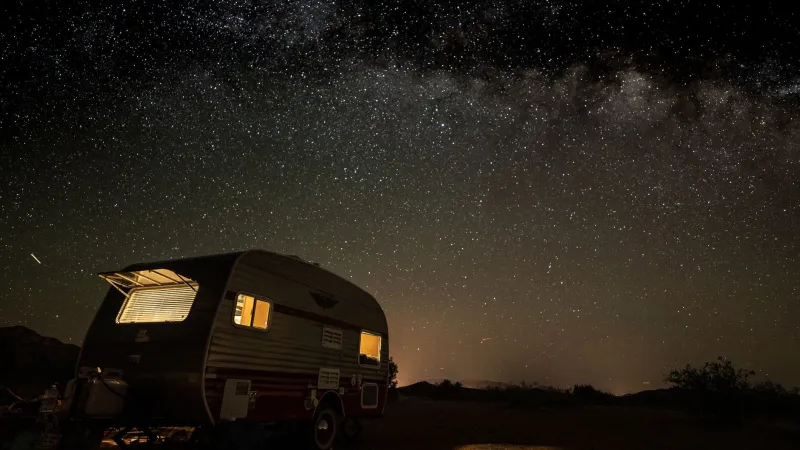
Stand far enough from a city, let your eyes adjust for twenty minutes, and something remarkable happens. The sky fills in. Stars appear where there were none. The Milky Way — that faint smear of light you've maybe only seen in photographs — materializes in full, stunning detail. It's one of the most humbling experiences a human being can have, and it's completely free.
The problem is light pollution. About 99% of Americans live under skies bright enough to wash out most of what's up there. But an RV changes the equation entirely. Park far enough from the glow of the nearest city, and the universe opens up. Here's where to point your rig.
Why an RV Is the Ultimate Stargazing Vehicle
Hotels don't come with rooftop decks in the middle of the desert. Stargazing requires patience, darkness, and the freedom to stay as long as you want. An RV gives you all three. You can set up your camp chair, pull out a telescope or a pair of binoculars, and linger until 2 a.m. without worrying about a checkout time. You've got your kitchen, your bed, and your bathroom — all within a few steps of the darkest sky you've ever seen.
For astrophotographers especially, the ability to park at a prime location, set up a camera on a tripod, and shoot for hours without disturbing anyone is genuinely hard to beat.
The Big Names: Dark Sky Parks Worth Every Mile
Cherry Springs State Park, Pennsylvania
Tucked into a remote plateau in north-central Pennsylvania, Cherry Springs is widely regarded as the best stargazing site east of the Mississippi. The park sits at 2,300 feet elevation with mountains blocking ambient light from surrounding towns, and it hosts a dedicated "Astronomy Field" with strict rules about white lights and car headlights after dark.
RV tip: The campground fills up fast — especially during new moon weekends and star parties. Book months in advance. Sites have electric hookups, but note that generator use is heavily restricted after dark to preserve the quiet experience.
Best season: May through October, with peak Milky Way visibility in July and August.
Big Bend National Park, Texas
Big Bend is one of the least-visited national parks in the lower 48, and that remoteness is exactly the point. Certified as an International Dark Sky Park, it offers some of the darkest skies in the continental US — and the landscape itself is dramatic enough to make your astrophotography look otherworldly.
RV tip: The Chisos Basin Campground has hookups, but for the darkest experience, the more primitive sites at Rio Grande Village or Cottonwood are worth considering if you're comfortable boondocking. Stock up on supplies in Marathon or Alpine before you head in — services inside the park are limited.
Best season: Fall through spring. Summer temperatures regularly exceed 100°F, which makes nighttime the only bearable part of the day — but it's still brutally hot.
Great Basin National Park, Nevada
Situated in a wide, flat basin with minimal light pollution for hundreds of miles in every direction, Great Basin is Nevada's most underrated gem. The park sits at high elevation — the visitor center alone is at 6,800 feet — which means thinner atmosphere and sharper stars.
RV tip: The campgrounds here are first-come, first-served for most of the season. Pull in during the day to claim your spot, then settle in for an extraordinary night. There are no hookups in the park, so make sure your batteries are charged and your propane is topped off.
Best season: Late spring through early fall, though the elevation means cold nights even in summer — bring layers.
Hidden Gems: Lesser-Known Spots That'll Blow Your Mind
Enchanted Rock State Natural Area, Texas
This massive pink granite dome in the Texas Hill Country isn't officially a dark sky park, but it sits far enough from San Antonio and Austin to offer genuinely impressive skies. The dome itself is a natural observation platform — hike up at dusk and you'll have a 360-degree view of the horizon as stars begin to appear.
RV tip: The campground books out quickly on weekends. Weeknight visits offer a much quieter, more intimate experience. Hookups are available at some sites.
Bruneau Dunes State Park, Idaho
Home to the largest single-structured sand dune in North America, Bruneau Dunes also houses a public observatory with a 25-inch telescope — one of the largest available for public viewing in the country. Ranger-led stargazing programs run on weekend evenings, making this a fantastic option for families or anyone who wants a guided introduction to the night sky.
RV tip: Full hookup sites are available, making this one of the most comfortable dark sky destinations on this list. It's a solid choice for first-timers who want the experience without sacrificing amenities.
Best season: Spring and fall offer mild temperatures and clear skies.
Headlands International Dark Sky Park, Michigan
For Midwest-based travelers, Headlands is a revelation. Located near Mackinaw City in northern Michigan, it's one of the few designated dark sky parks within a reasonable drive of major Midwest metros. The park also happens to be one of the best spots in the continental US to catch the Northern Lights during periods of solar activity.
RV tip: There are no hookups at Headlands itself, but the surrounding area has private campgrounds with full amenities just a few miles away. Position yourself close enough to drive to the park after dark.
Best season: Fall and winter for aurora potential; summer for Milky Way viewing.
Practical Tips for Stargazing by RV
Kill your generator early. Most serious stargazing happens between 10 p.m. and 3 a.m. Shut down noisy equipment beforehand and let the silence (and darkness) set in.
Use red lights only. White flashlights destroy your night vision, which takes up to 30 minutes to fully develop. Pick up a red-light headlamp before your trip — it makes a genuine difference.
Plan around the moon. A full moon is nearly as disruptive as city lights when it comes to viewing faint objects. Schedule your stargazing nights around the new moon phase for maximum darkness.
Download a sky map app. Apps like SkySafari or Stellarium let you identify constellations, planets, and deep-sky objects in real time. Point your phone at the sky and it maps what you're looking at.
Dress warmer than you think you need to. Clear skies mean no cloud insulation. Even summer nights at elevation can drop into the 40s. Bring an extra layer and a blanket for your camp chair.
The Sky Is Still Out There
Light pollution has robbed most of us of something ancient and essential — that instinctive sense of scale you get from staring into a genuinely dark sky. The stars haven't gone anywhere. They're just waiting for you to drive far enough to find them.
An RV is the most flexible, comfortable, and rewarding way to do exactly that. Pick a destination, check the moon phase calendar, and point your rig toward the dark.
Find your perfect stargazing road trip vehicle at AnyTime RV Rental.